

Are flowers making them sick?
As flower farmers, we are committed to keeping our land and flowers as clean as possible. We built up our soil over a period of a few years by bringing in horse manure from an owner we know did not spray chemicals, grew cover crops, and built our flower beds with organic compost. We fertilize our flowers with fish emulsion and calcium extracted from eggshells from our kitchen. We simply don’t want to work and live around chemicals that cause health problems. We have pets and grandchildren who are constantly around our home and flower fields. We sell our flowers to people who live in our community and to florists within our community. We want to provide beautiful flowers for you, but we also want to provide flowers that are not compromised by chemicals.
I have done some reading on the subject of chemicals in the cut flower industry and the information is alarming, but not really surprising. None of us wants to handle things that are covered in pesticides and carcinogenic chemicals, especially something as beautiful as flowers! The risk is, admittingly, greatest for the floral industry workers, including those who harvest and process the flowers, typically in other countries, but also for the florists in our community who work with those flowers every day.
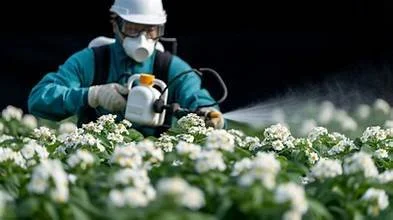
Because most consumers want perfect flowers, and hopefully inexpensive flowers, the majority of cut flowers come into the U.S. from Colombia and Ecuador, and sometimes Kenya and Ethiopia. In order to be profitable, they cannot afford to lose flowers to bugs, pests or disease so they spray them with pesticides. The lucky field workers are provided protective suits and masks, but not all are so lucky. After the flowers finally reach our florists (let’s not even talk about the carbon footprint), they handle them all day long to create beautiful arrangements that make their way into our homes, our weddings, and other celebrations.
What is the answer? As a local flower farmer, I feel very good about offering flowers to our customers that are free from these chemicals. But locally grown flowers are completely seasonal. That means I cannot provide peonies in August, or zinnias in April, or dahlias in May. Maybe we all need a shift in the way we think about flowers and accept that we should work within the seasons of what blooms at a specific time of the year. There is a florist in Baltimore, Ellen Frost of Local Color Flowers, (http://www.locoflo.com/) who only uses locally grown flowers. For her that means from flower farmers within approximately 100 miles of her studio. Her model is one that allows her to know who is growing the flowers she uses so that she can be sure her flowers are pesticide-free, in addition to being super-fresh and will provide the longest vase life possible.
Like most things, this is information you can do with what you will. The old phrase that “when we know better then we do better” (or something like that) can be true if you want it to be true. For me, that means I am reading labels of the foods I purchase and attempt to buy things that are made with clean ingredients I can pronounce and understand what they are. I buy organic when possible. While I’m not 100% there yet, I am paying attention and making changes every day. One way I continue to do this is by our flowers. You can rest assured that the flowers we grow are free from chemical pesticides. They are harvested at the proper stage, conditioned, and made into bouquets that you can enjoy!
I hope you, like me, continue to work towards being as healthy as possible by choosing to eat clean food and bring things, like flowers, into your home that are also clean.
If you would like to read a bit more about this topic, here are three of the many articles I’ve recently read that discuss this in greater detail:
1) Pesticide Residues on Three Cut Flower Species and Potential Exposure of Florists in Belgium https://pmc.ncbi.nlm.nih.gov/articles/PMC5086682/#sec5-ijerph-13-00943
2) The environmental impact of cut flowers? Not so rosy https://ideas.ted.com/the-environmental-impact-of-cut-flowers-not-so-rosy/
3) ‘There’s a dark side to floristry’: are pesticides making workers seriously ill – or worse? https://www.theguardian.com/society/2026/jan/11/theres-a-dark-side-to-floristry-are-pesticides-making-workers-seriously-ill-or-worse